Inside the IELTS Writing Simulator we built for Language schools

There are a lot of tools out there that will mark an essay and hand back some feedback. Very few of them are actually built to replicate the exam itself, and fewer still are built by someone who has spent years on the other side of the desk, marking real IELTS essays.
I've spent fifteen years teaching English and marking IELTS writing. This is what months of work, built specifically for language school teachers, actually looks like under the hood.
An IELTS writing test that behaves exactly like the real exam
The single biggest thing that separates real exam performance from practice performance is pressure and conditions. A student who writes a beautiful essay at home with unlimited time, spellcheck on, and the ability to look things up isn't practising the exam - they're practising something else entirely.
So the simulator recreates the real thing as closely as possible.
Students get tailored questions for both Task 1 and Task 2, pulled from a question bank with a wide range of styles and categories, so they're not memorising the same handful of prompts. Every test is timed, exactly like the real exam. There's no spellcheck. There's no copy-paste. Students have to actually write the answer themselves, under the same pressure they'll face on test day, using only their own knowledge.
A student who's only ever practised with a safety net has no idea how they'll perform without one. This gives them that experience before it counts.

Marking, done for you
Every essay a student submits is automatically marked. No stack of scripts to work through in the evening, no inconsistent marking between different teachers at your school - every student gets assessed the same way, instantly.
You can see all of your students' work in one place, already scored, without lifting a red pen.
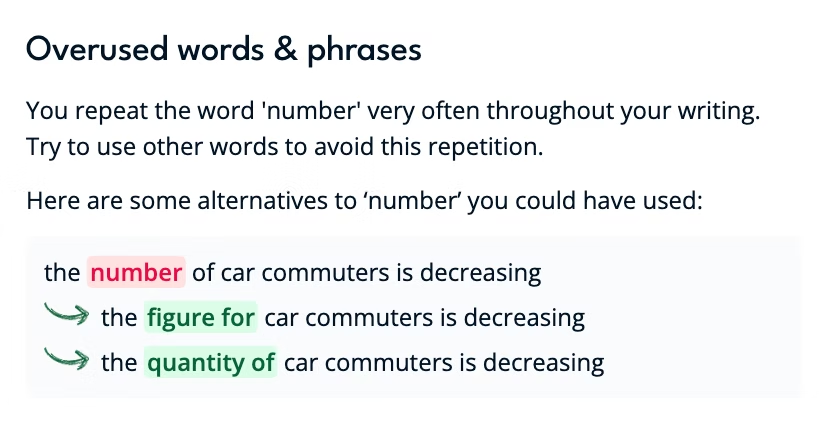
Read more about the detailed feedback the students get.
Class-level error analytics — the part teachers keep asking for
This is the feature I'm most excited about, because it changes what a teacher can actually do with the data.
Instead of just seeing individual scores, you get a breakdown of the most common grammar errors across your whole class. So if your students collectively made fourteen article errors last week, that shows up clearly as one of your top error categories.
Click into that number, and you don't just see the count - you see the actual examples pulled from your students' own essays. That means you can walk into your next lesson already knowing exactly what to teach, and with real examples from your own class to teach it with, instead of guessing what your students are struggling with or building a generic grammar lesson that may not even be relevant to them.
This turns marking data into lesson planning. You're not just finding out how your students did - you're finding out what to do about it.

Engagement stats, at a glance
Alongside the error breakdowns, you can see who's actually using the tool. The dashboard shows your most active students - who's taking the most tests, and how many they've completed - so you can see engagement at a glance, spot the students who are putting the work in, and identify who might need a nudge.

Built by a teacher, checked like one
Every part of this has been built the way I'd want it built if I were still marking essays myself. The marking engine has been trained and verified against real, examiner-marked essays. The question bank has been written with genuine IELTS task types in mind, not approximations. The error analysis reflects what actually shows up in real student writing, not a generic list of common ESL mistakes.
It's taken months to get here, and we've checked every step of it against real teacher judgement.
We hope it saves you time, tells you something useful about your class, and gives your students useful exam practice. As always, we're on hand to hear your feedback.
— Francis